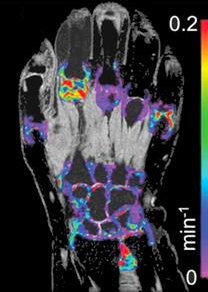
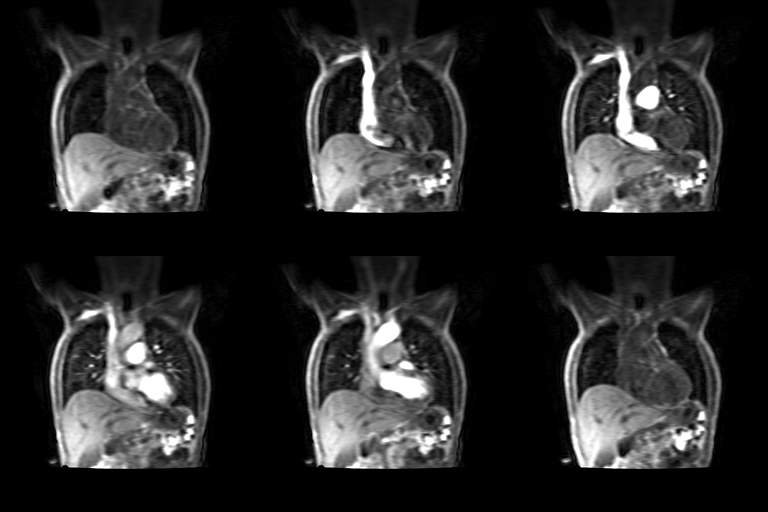
The extended Tofts model is a widely used pharmacokinetic model in DCE-MRI. It describes how contrast agent moves between the blood plasma and the extravascular extracellular space.
In practical terms, the model helps translate a changing MRI signal into biologically meaningful parameters. The main parameter, ktrans, reflects the transfer of contrast agent from plasma into tissue, and is influenced by both blood flow and capillary permeability. The parameter ve represents the fractional volume of the extravascular extracellular space, while vp represents the fractional plasma volume. Together, these parameters can provide insight into tissue vascularity, endothelial permeability, and microenvironment.
Although mathematically compact, the extended Tofts model is powerful because it links image data to physiological processes. For this reason, it is widely used in oncology, inflammation and other applications where vascular function matters. Its strength lies in providing quantitative biomarkers that can support tissue characterisation, treatment response assessment, and longitudinal monitoring.